The Forge of Empires idle town, played properly
Workshops feed a transport, the transport feeds a market, and a fixed amount of town currency finishes the town. The whole game is working out where the chain is slowest and how far it is worth pushing before you stop spending and start saving — which is a harder question than it looks, because production jumps at a rank threshold and only creeps in between.
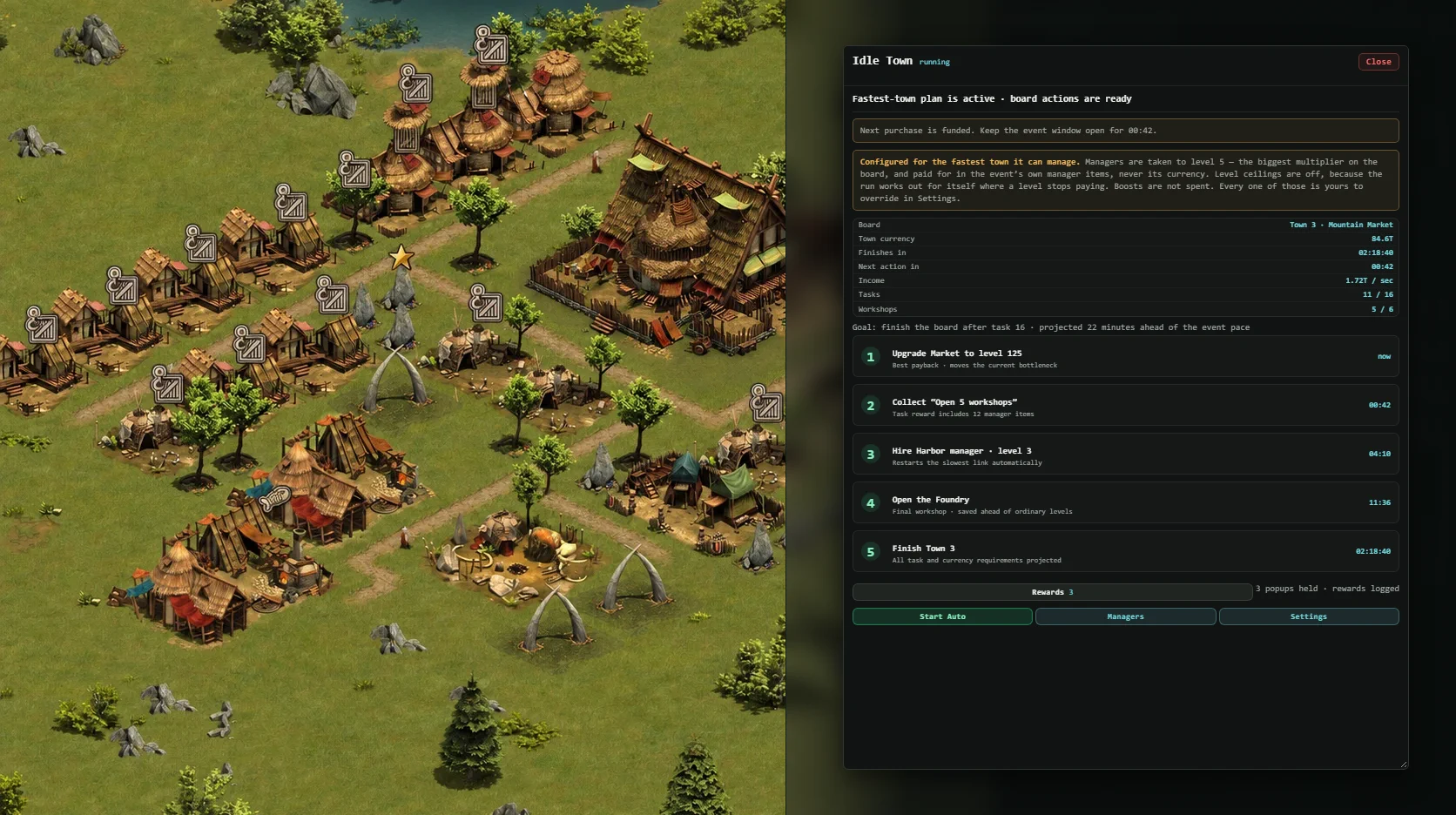
Real Defiant interface with fictional, privacy-safe values. Forge of Empires is shown only to demonstrate how the extension appears in use.
What it actually does
Finds the slow link
Throughput is the slowest of the three stages, not the sum, so currency spent anywhere else buys nothing until the bottleneck moves. Everything is ranked on what it does to that one link.
Looks ahead, not just at the next buy
There is a stretch below every rank threshold where each single level is a bad buy and the run of them is a fourfold jump. A one-step rule stalls there for good; a search does not.
Knows when to stop
Past a point, another level costs more time to pay for than it saves. The planner banks instead, and says so rather than looking idle.
Spends nothing you did not agree to
Managers are paid for with the event's own items. Event currency — the kind bought with diamonds — has a budget you set, and it is zero unless you change it. Boosts stay unspent.
How it is going
The planner predicts how long each town will take before it starts it. Those predictions are checked against how long the towns actually took, anonymously and only from players who leave sharing on, because a model nobody scores is a model nobody can tell is wrong.
Nothing recorded yet. The table fills in as towns are finished.
How it works in practice
- Open the event's idle town once so the panel can read the board.
- Press Start in the Idle Town window.
- It hires the managers, opens the workshops as they unlock, and buys levels where they do the most good.
- It collects finished tasks, which is what releases the next one.
- When the town is paid for it finishes it and starts the next.
- The panel shows a countdown to the next moment it needs you there, so you can leave it and come back on time.